Dr Edward Goldenberg
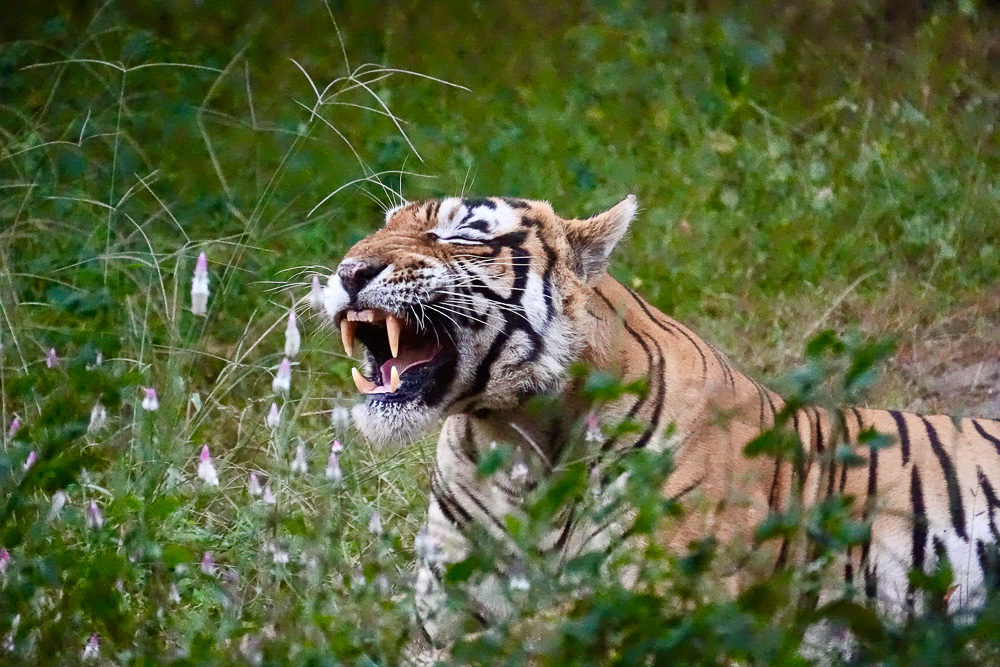
November 2026 - Tiger Canine
About the Image(s)
The Bengal tiger is a population of the Panthera tigris tigris subspecies. It ranks among the largest of wild cats. It is distributed from India, southern Nepal, Bangladesh, Bhutan to Southwestern China. It is threatened by poaching, habitat loss and habitat fragmentation.
As of 2022, the Bengal tiger population was estimated at 3,167–3,682 individuals in India, 316–355 individuals in Nepal, 131 individuals in Bhutan and around 125 individuals in Bangladesh. It is the national animal of India and Bangladesh.
There are four tiger reserves in India open to the public This tiger was seen at the Ranthambhore tiger reserve. In only one of four , four hour safaris did I see any tigers.
14 comments posted
Actually, Ed, there are more than four reserves where you can see tigers, and a total of 58 developed since Project tiger commenced a number of years ago. I'm glad you had the opportunity to see a tiger. Most people who visit Rathambhore don't see any. And you got a good image to boot. The close-up of the cat with his/her? open mouth is a dramatic rendering in your well-exposed image. It has great impact and tells a story of ferocity that I believe you wanted to convey. If you presented the image in portrait style it might have added to the dramatic presentation of this original image. On the down side, this image would not likely be suitable for competition in travel as it doesn't depict anything that you took this image outside of a local zoo. If you recall the image I submitted last month of the tiger walking across the road in front of safari vehicles that documented that the image was taken in that setting, and suitable for competition. But you have an image you can be proud of anyway. As an afterthought, congratulations on your receiving a service award for two years of service as our group administrator. Posted: 11/01/2026 06:50:02
Where did you find out about the service award. The images were taken with SonyRX10M5 which has the most unbelievable auto focus. The image was taken at iso 6400, 533mm, f4, and 1/400sec. It was set on speed to prevent out of focus images Posted: 11/02/2026 18:47:56
Ed, It was posted in the Photo Travel Newsmagazine Posted: 11/02/2026 19:28:18
The award was first listed on page 43 in the Fall Photo Traveler Issue that came out in early October, and then again in the November issue of the PSA Journal. Posted: 11/03/2026 05:39:53
Doc, Good image of the tiger. Typical yawning face expression with the eyes closed. By any chance do you have any more images of the tiger before or after this one, since the anatomy of the head looks awkward. Indeed a nice set of canines.
The PTD guidelines states that the animals have to be in their natural environment, which to me it applies here.
https://psa-services.org/ES/ptd-judges-guide-english.pdf Posted: 11/02/2026 16:33:41
The PTD guidelines states that the animals have to be in their natural environment, which to me it applies here.
https://psa-services.org/ES/ptd-judges-guide-english.pdf Posted: 11/02/2026 16:33:41
Posted: 11/02/2026 18:49:10
Isaac, you only listed part of the guidelines. The remaining clause of the guidelines says as follows: "... if the animals are in their native environment and are characteristic of that country, region, or continent;" Here the image could have been taken at a local zoo and there is no indication that it was taken in India. Last month I posted an image of a tiger taken in India, but I chose that image deliberately rather than the ones I posted in reply to Vinaya's comments, because the image I posted documented the safari vehicles that demonstrated that the image was taken in India, and not at a local zoo. But it's a nice image regardless. Posted: 11/03/2026 05:46:01
(Group 2)
Alan, I think you are misunderstanding the concept of 'charastic of country, region or continent'. This refers to animals being endemic to a specific region, such as King Penguins in Antarctica or Kangaroos in Australia. Since these animals are endemic, there is no question about the geographical location of the image. I do agree the definition ALSO states the word 'native environment' which does suggest that zoo images are not permitted.
Mr. Google tells me that Bengal Tigers are found in India, Nepal, Bangladesh and Bhutan, but that 75% of the population live in India. This is probably enough to assume that the Bengal Tiger is endemic to India. Posted: 11/12/2026 21:40:35
Mr. Google tells me that Bengal Tigers are found in India, Nepal, Bangladesh and Bhutan, but that 75% of the population live in India. This is probably enough to assume that the Bengal Tiger is endemic to India. Posted: 11/12/2026 21:40:35
Jen, I'm not mistunderstanding it al all. I will grant you the fact that due to the pressures developed over time, bengal tigers 'endemic' aspect primarily refers to India, but here, there is no evidence that the tiger is in its native environment (meaning actually in India) rather than a contrived environment created in a zoo. to qualify as a travel image, there needs to be evidence that the image was actually captured in India. Endemic merely means that the animals are naturally found in particular environments, and some animals are endemic to very small natural environments, such as the penguins you name, but also true to Lemurs in Madagascar just to cite other examples. I would suppose, due to former pressures on the species, bengal tigers are endemic to small areas in central India, when their former ranges were broader than now. Definitions are restrictive and meant to be so. I have just had an article I wrote on visiting central India to see those very bengal tigers rejected by the PSA travel division's Photo Traveler newsletter for just those reasons. The article was judged not to be a travel article but rather a nature article, despite the fact that I provided images that demonstrated beyond the shadow of a doubt that the images were taken in the natural environment and contained human involvement, such as my comment to Isaac, to which you replied, and thereby making those images unsuitable, by definitions, as a nature image, as nature images may not show human presence. Posted: 11/13/2026 05:27:45
Posted: 11/02/2026 18:52:08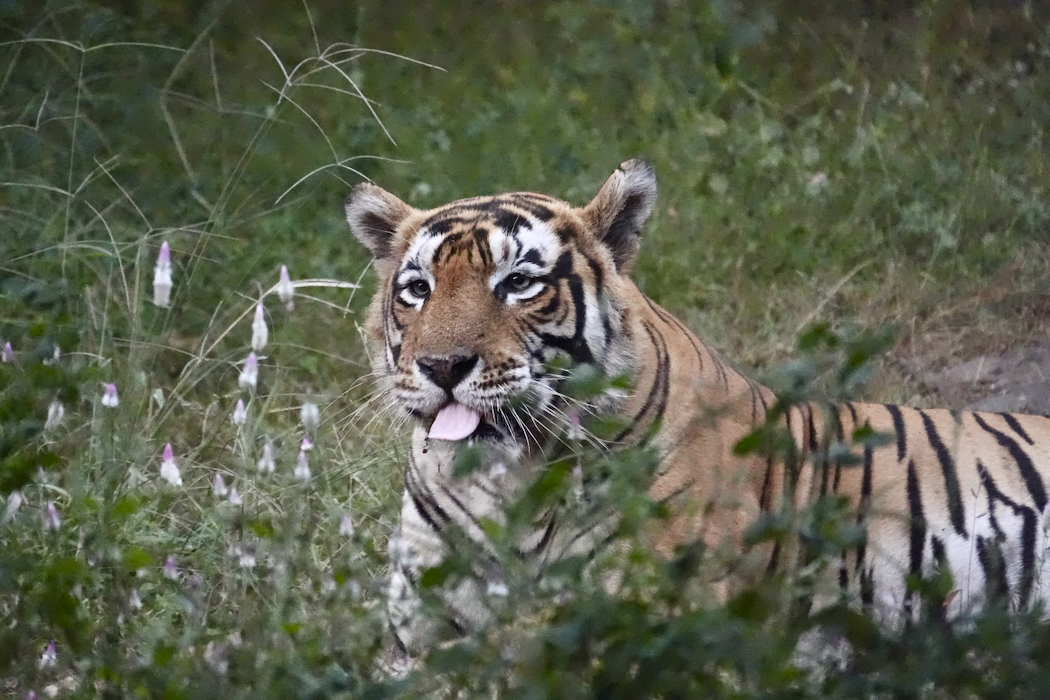
Ed, this image is way better than the submitted one. A couple of adjustments: tongue a little redder, and a little light on the eyes. Posted: 11/02/2026 19:26:24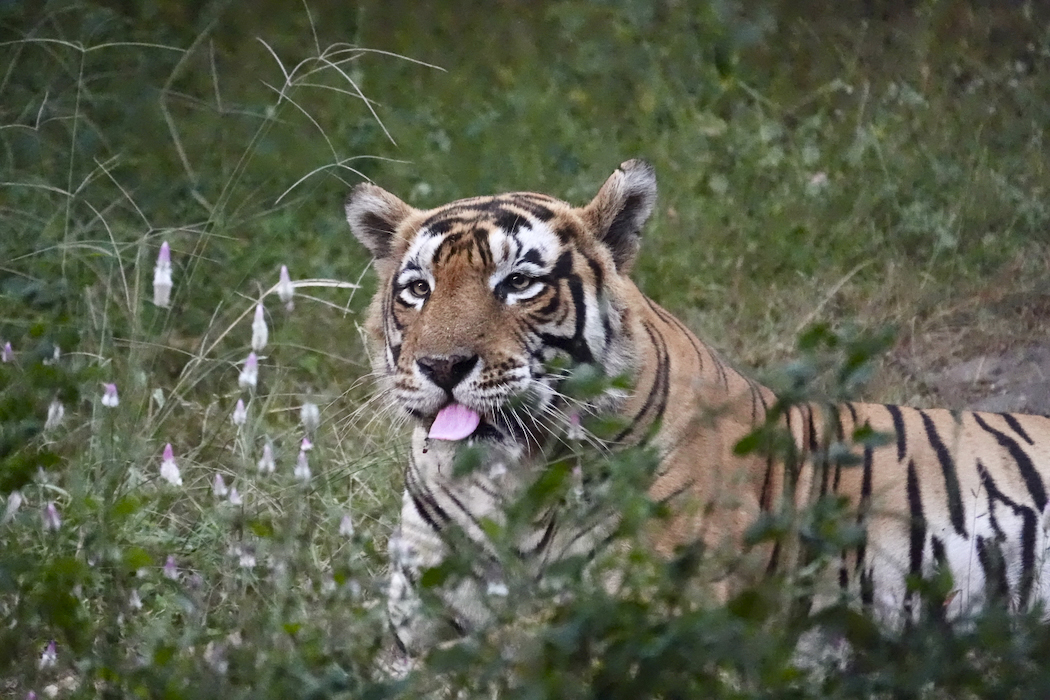
Thank you Isaac Posted: 11/02/2026 19:40:42
I disagree. The image Ed posted has a far greater impact than this one. In his image posted initially, the emotional impact is of a ferocious predator with bared teeth waiting to tear some prey apart. It is clearly original. This replacement image doesn't have any of the impact of the original posted image, as it appears the animal is making fun of something with its tongue stuck out. I don't know what the AF setting on the RX10M5 means, but suspect it was a tracking AF. Given that you were that close, you would have done better to sue spot-Medium as your AF. The animal wasn't moving across your field of vision and you didn't need to use tracking. The color could have been enhanced if you compensated at -.3. In general, doing that enhances the colors without making the image appear underexposed. Posted: 11/03/2026 05:53:36
I wish I had something to add but I applaud the lively discussion around the definition's clause that deals with animals. Posted: 11/16/2026 08:50:34